Overview of projects
Bifrost is an integrated CCS development in the Danish North Sea, designed to establish Denmark as a long‑term, reliable CO2 storage hub for Northern Europe.
It brings together offshore CO2 transport and permanent geological storage in a scalable, open‑access system that can support hard‑to‑abate industries in Denmark and beyond.
Building on decades of Danish offshore experience and existing infrastructure, Bifrost connects onshore CO2 capture with secure storage deep beneath the seabed, enabling large‑scale emissions reductions where alternatives are limited.
As an EU‑designated Project of Common Interest, Bifrost plays a key role in Europe’s climate transition by accelerating the deployment of safe, efficient and commercially viable CO2 storage solutions in the North Sea.
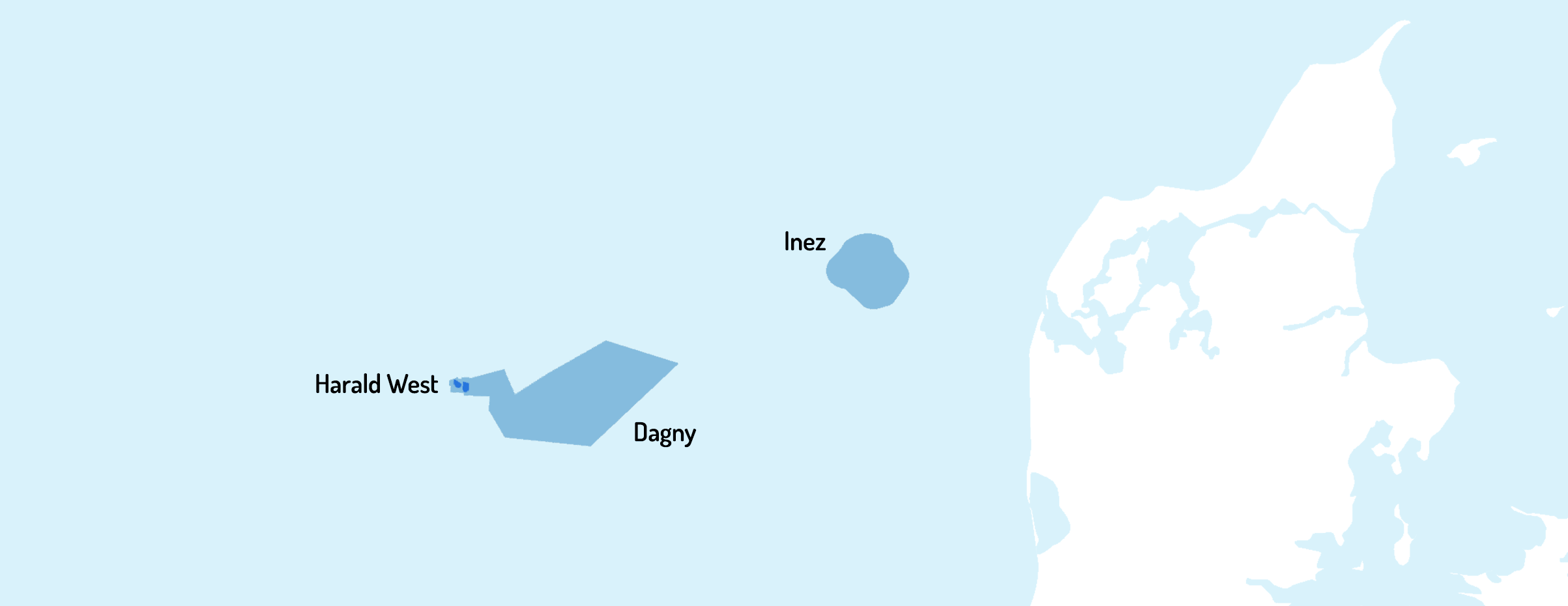
It comprises three storage licenses developed in two projects: Project Harald & Dagny and Project Inez.
A special European status
Bifrost is a large‑scale CCS initiative in the Danish North Sea, developed to position Denmark as a leading CO2 storage hub supporting Europe’s goal of climate neutrality by 2050. Bifrost will transport CO2 from industrial sources and store it permanently offshore, with operations planned to start around 2030.
Originally designated a Project of Common Interest (PCI) by the European Union in November 2023, Bifrost received renewed PCI status from the European Commission on 1 December 2025. PCI status enables streamlined permitting and access to EU funding under the Connecting Europe Facility program (CEF), confirming the project’s strategic European importance.
Coordinated by TotalEnergies, Bifrost brings together partners across the CCS value chain, including Nordsøfonden, Ørsted, Evida, Port of Esbjerg, ADP, ARC, Ontras and VNG. Bifrost is designed to store up to 335 million tons of CO2 over approximately 35 years, supporting emitters in Denmark, the Baltic region and Northwest Europe, and helping decarbonize hard‑to‑abate industries through secure, permanent offshore storage.