Project Bifrost Phase 1: The Dagny and Harald licenses
Phase 1 covers the Dagny and Harald storage licenses and represents the first development phase of Project Bifrost. Its primary objective is to establish the initial offshore CO2 transport and storage system in the Danish North Sea and enable early, large‑scale CO2 injection.

The scope of Phase 1 includes:
- Development of permanent CO2 storage in the Harald depleted gas fields and the Dagny saline aquifer, supported by extensive subsurface data and appraisal activities
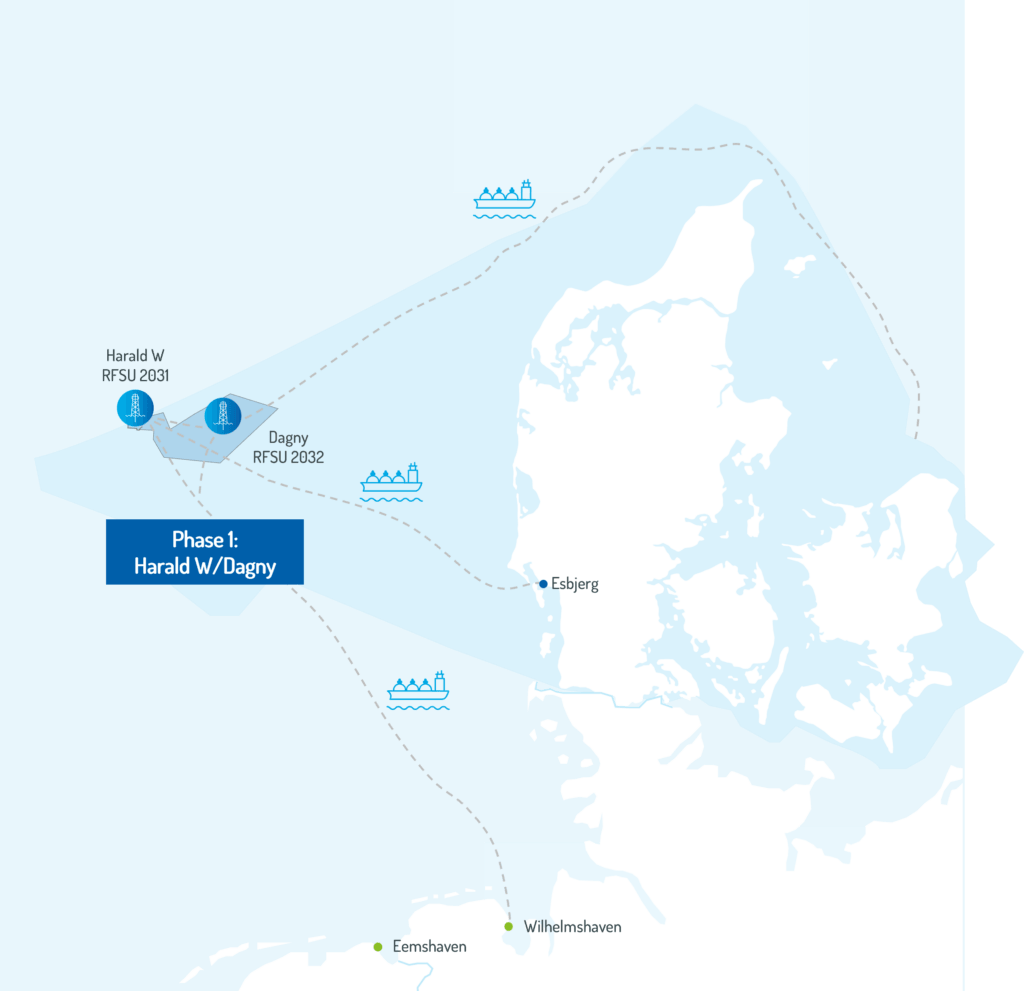
- Establishment of offshore CO2 transport solutions, including ship‑based transport and offshore offloading or injection concepts
- Reuse and adaptation of existing offshore infrastructure where feasible, leveraging decades of North Sea operational experience
- Demonstration of safe, reliable and scalable CO2 storage operations to reduce risk and accelerate deployment
- Delivery of initial storage capacity to support hard‑to‑abate industries in Denmark and neighboring regions
Phase 1 is designed to validate technical concepts, mature commercial models, and create a robust foundation for the future expansion of Project Bifrost.
Short facts
- Licenses awarded: February 2023
- Geological storage complex: Depleted offshore gas fields (Harald West and Harald East) and saline aquifer.
- Owners: TotalEnergies (operator) 45%, CarbonVault 35% and Nordsøfonden 20%
- Storage potential: 4.1 Mtpa from 2030+
- Location in the North Sea: 250km off the west coast of Denmark
- License area: ~2,118 km²
Harald West and Dagny storage sites

Harald West depleted gas fields
The Harald gas fields, consisting of Harald West and Harald East, are situated on the far western edge of the Danish North Sea, approximately 250 km from the shore. Discovered in the 1980s, these two gas reservoirs have been in production since 1997 and are currently managed by TotalEnergies. The Harald West storage complex comprises sandstone, sealed by layers of shale and chalk at a depth of around 3,400 meters. Following the end of gas production, CO2 will be injected into the sites for secure storage below initial pressure levels. The reservoir seal, which has contained natural gas for millions of years, ensures safe and permanent CO2 storage.
Dagny saline aquifer
The Dagny saline aquifer structure in the vicinity of the Harald fields represents an opportunity to provide some of the storage capacity required for Bifrost and which has been assessed from preliminary studies. A saline aquifer is an underground rock formation containing salty water (brine) that is unsuitable for human consumption or agriculture and covered by an impermeable rock that allows the CO2 to be permanently contained. The depth must be sufficient (800 meters or more) to ensure that the CO2 is sufficiently compressed. These formations are found deep below the Earth’s surface and can store significant amounts of CO2 safely and securely.

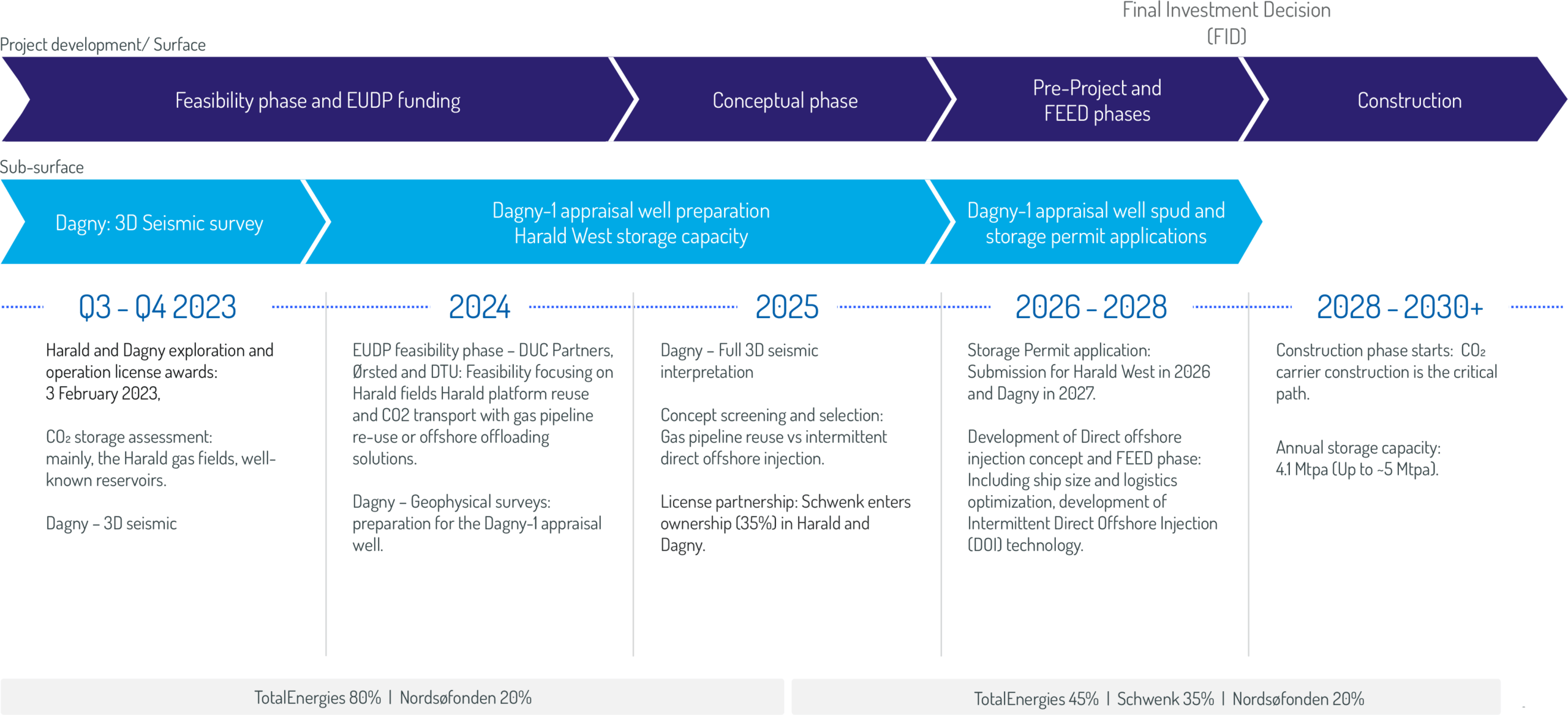
Phase 1 Timeline